How to Find Low Competition Keywords: My 6-Step Process
Most keyword research advice says the same thing: pick a keyword with a low difficulty score and start writing. I followed that advice for a long time, and I wasted a lot of articles on keywords I never had a real chance to rank for.
I’m Irfan Ghaffar, and I do local SEO and ecommerce SEO for small businesses. Today, before I write a single word, I check who is actually sitting on page one, how strong those sites really are, and whether Google is struggling to find a good answer. If those signals line up, I go after the keyword. If they don’t, I move on, whatever the KD score says.
This is the exact process I use for my own site and for clients. I’ll use a local keyword, plumber in New York, as the running example, because local SEO is where I do most of my work.
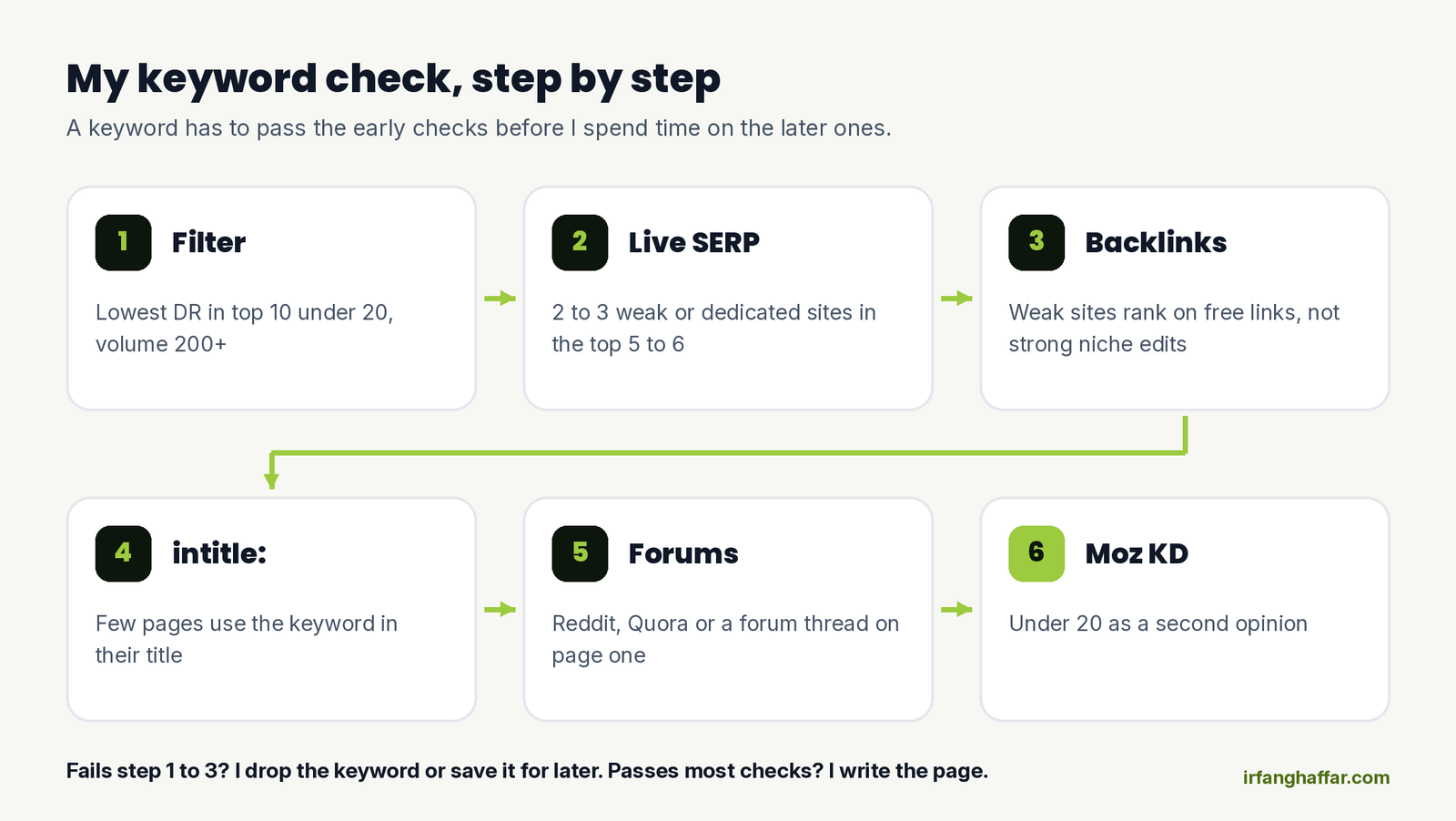
The 6 signals I check before I target a keyword
- A site with a DR under 20 already ranks in the top 10.
- The keyword gets at least 200 searches a month (I adjust this by service).
- Two or three weak or dedicated sites sit in the live top 5 to 6 for the target location.
- Those weak sites don’t have strong backlinks behind them.
- Only a small number of pages use the keyword in their title.
- Reddit, Quora or a forum thread ranks for it.
Keyword Difficulty from Moz is my last check, not my first.
Step 1: Filter for keywords where a low DR site already ranks
I start in Ahrefs Keywords Explorer. I type a seed keyword for the service, open the Matching terms report and add two filters.
- Lowest DR in the top 10: under 20. If a website with a Domain Rating below 20 is already on page one, Google is telling me that authority is not the deciding factor for this search. That is the opening I’m looking for.
- Search volume: 200 or more. This is my starting point, not a fixed rule. For a high-ticket local service, like a dental clinic, 50 searches a month can bring real clients. For a broad blog topic, I set it higher.
This one filter removes most of the keywords I would otherwise waste time on. A keyword with a nice volume but only DR 70+ sites in the top 10 is a keyword for later, once my site has more authority.
No Ahrefs subscription? You can still follow this process. Search the keyword on Google, then check each ranking domain in Ahrefs’ free Website Authority Checker to see its DR. It’s slower, but the logic is the same.
Step 2: Check the live SERP from your target location
Tool data can be weeks old. The search results page is what Google shows today, so this is the step I never skip.
I search the keyword from the location I want to rank in. For a US keyword, I either use a VPN or change the search location in Google. This matters a lot for local SEO. Someone searching “plumber in New York” from Lahore does not see what a person in Brooklyn sees.
With the Ahrefs SEO Toolbar extension turned on, every result shows its DR right under the link. I look at the top 5 to 6 organic results and ask one question: are two or three of them weak sites?
Look for dedicated sites
A dedicated site is built for one service in one place. Its home page targets only that keyword and nothing else.
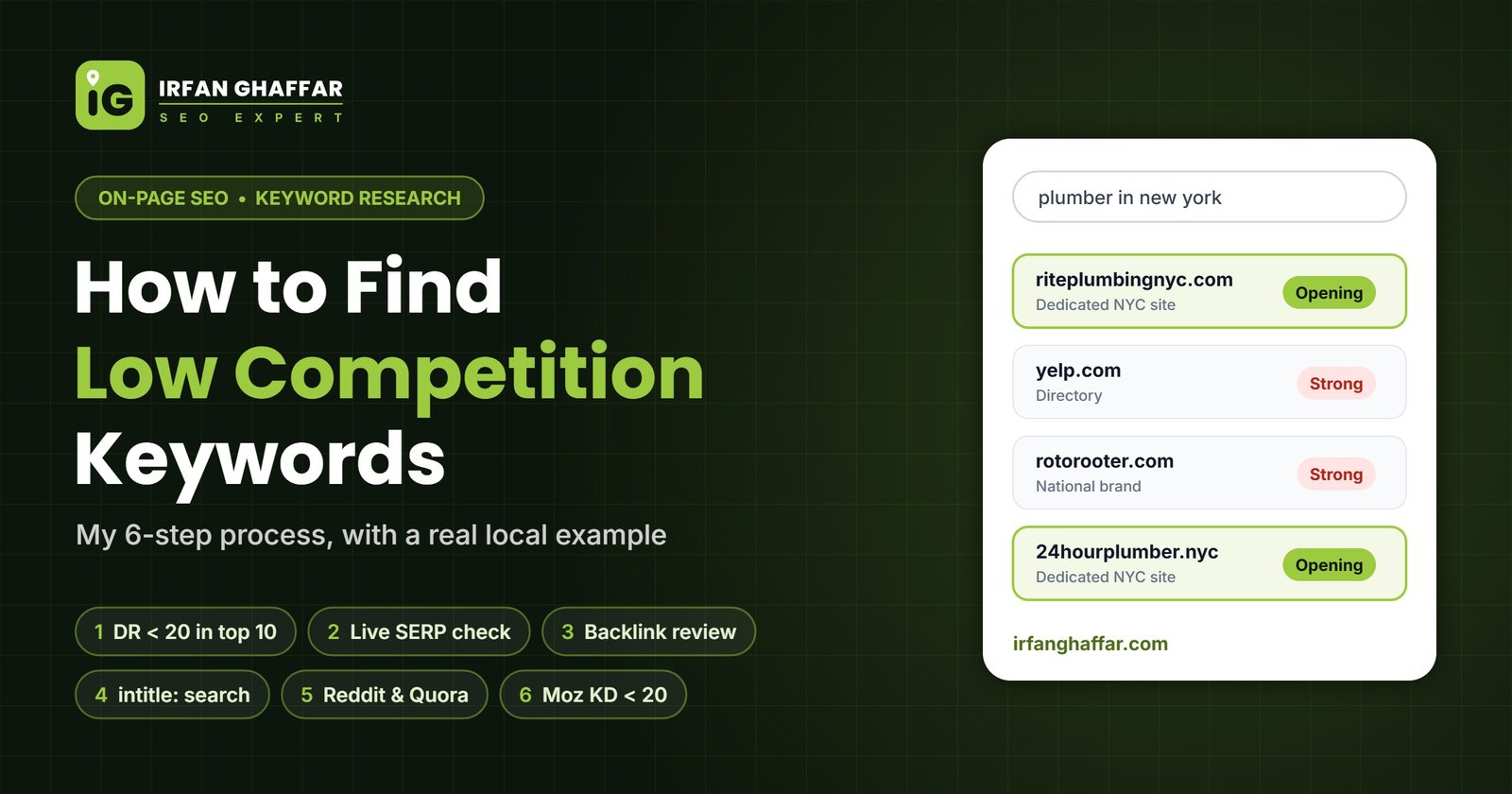
When I searched “plumber in New York” with US settings, the first organic result was Rite Plumbing NYC, a site built around plumbing in New York City. It sat above Yelp and Roto-Rooter. Further down was 24hourplumber.nyc, another site made for one city and one service.
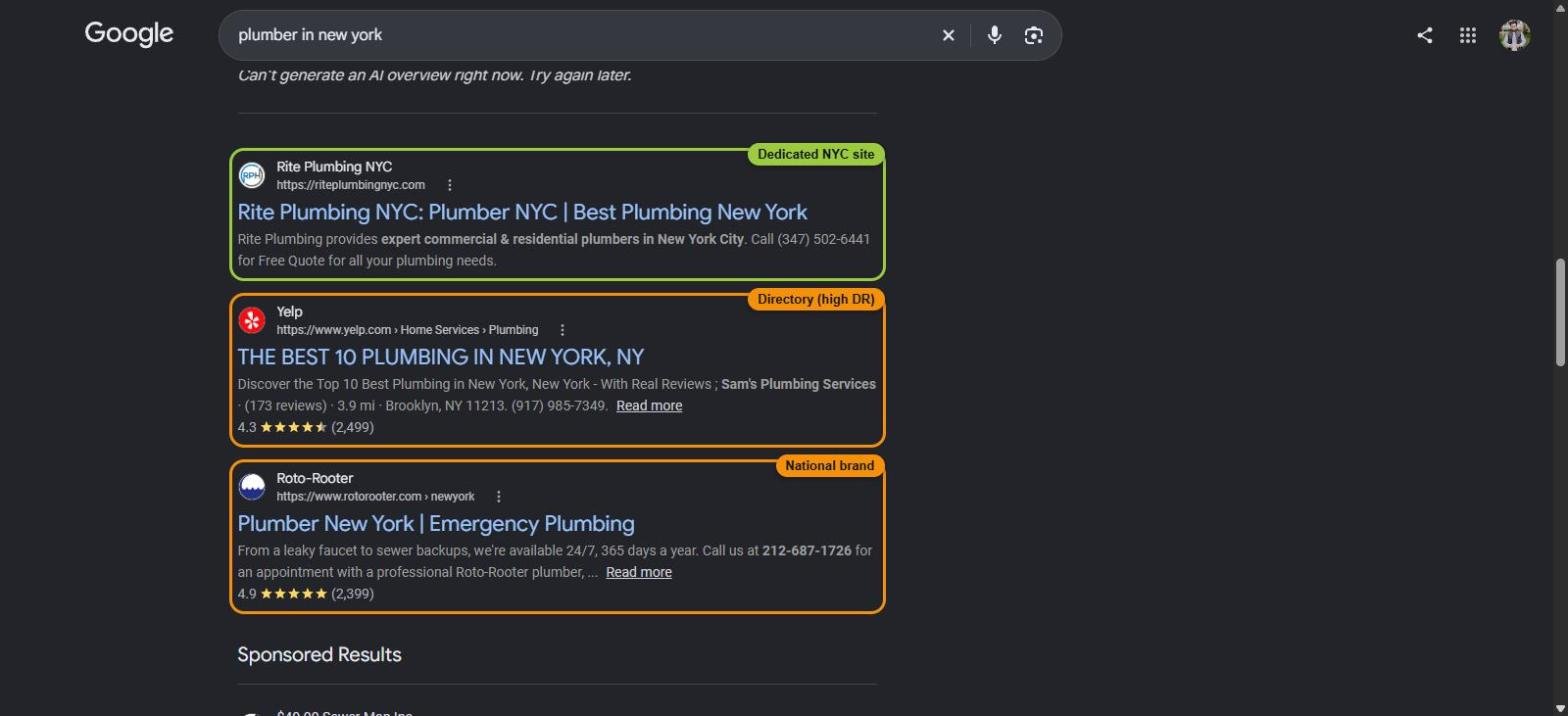
When I see two or three dedicated sites like this on page one, I know a focused page with the keyword in its title, a clear service and real local signals has a fair shot. You can see what those local signals look like in my Sydney clinic case study. Directories like Yelp, Angi and Thumbtack will still be there, but they don’t take every spot.
One more thing on local keywords: the map pack shows above the organic results. If you want those calls, your Google Business Profile needs work too, not just the page.
Step 3: Open the backlinks of the weak sites
A low DR does not always mean a weak site. DR is a score based on links, and a site can have a low score with a few very strong links behind it. So for every low DR site I find in the top results, I open its backlink profile in Ahrefs Site Explorer and look at what kind of links it has.
- Guest posts on relevant sites. These take effort to match.
- Niche edits on strong, related pages. A few of these can hold a ranking for a long time.
- Paid links from link farms. Easy to spot, and usually not a real threat.
- Free links only: directory listings, citations, profile links and blog comments.
If the site ranks mostly on free links and citations, I know I can beat it with a better page and a handful of good links. If it has strong niche edits from relevant sites, it’s stronger than its DR suggests, and I plan for that before I commit.
This is the difference between a keyword that looks easy and one that actually is.
A real example: riteplumbingnyc.com
Remember Rite Plumbing NYC from Step 2? Ahrefs’ free Website Authority Checker shows it at DR 22, right on my line of 20. On paper, that looks like a weak site.
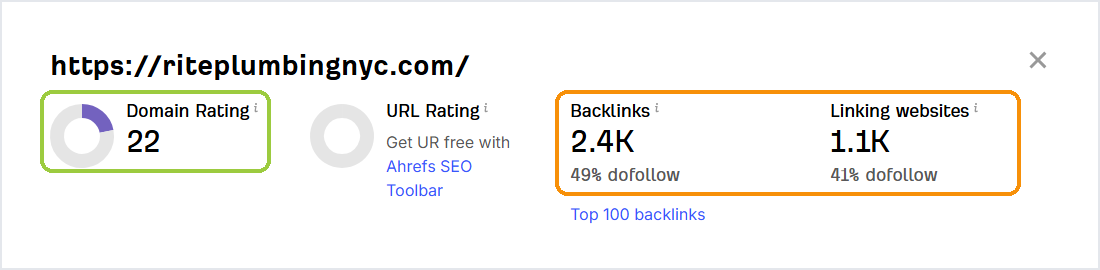
Then I opened its backlinks in Ahrefs’ free Backlink Checker. Its top linking sites include a Wirecutter guide on nytimes.com (DR 94), a HubSpot blog post (DR 93) and Duct Tape Marketing (DR 77). Those are editorial mentions, not directory links. The rest are mostly “best plumbers” lists, local guides and one forum thread.
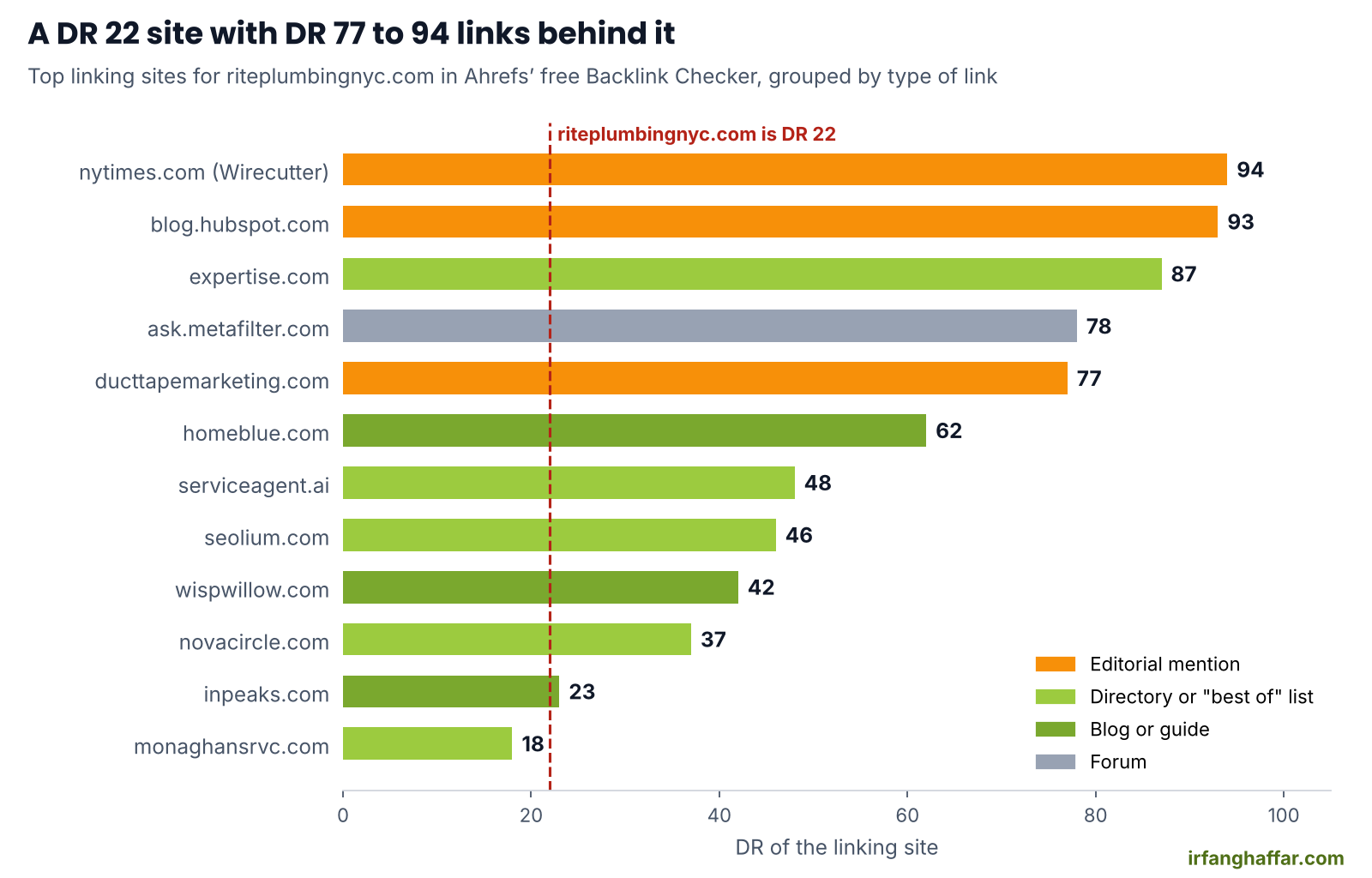
So this DR 22 site is much stronger than its number. The keyword can still be worth going after, because the other signals are good, but I’d go in knowing I need a better page and a few real editorial links, not just citations. This is exactly why I never stop at the DR score.
Step 4: Count how many pages use the keyword in their title
This check is free and takes ten seconds. I go to Google and search the keyword with the intitle: operator, like this: intitle:"plumber in new york"
Google then shows only pages that have that phrase in their title tag. The fewer pages I see, the fewer competitors are actually optimising for the keyword, and the better my chances.
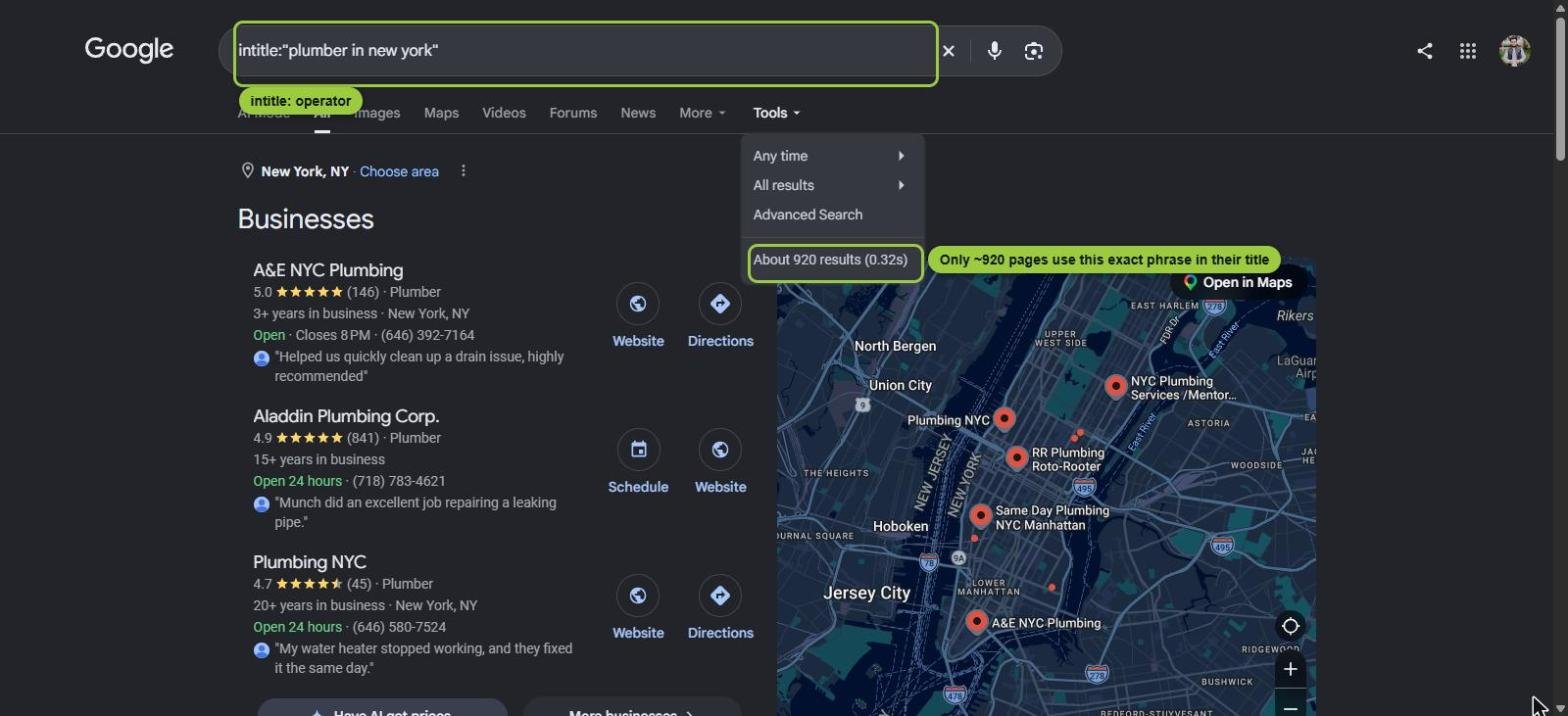
Two tips from using this a lot:
- Compare keywords against each other. The result count Google shows is an estimate, so I don’t treat it as an exact number. I use it to see which of my keyword options has the fewest optimised pages.
- Try allintitle: as well. It finds pages that have all the words in the title in any order, so it catches pages that use the words but not the exact phrase.
If the top results don’t use the keyword in their titles, that’s a gap. A page with the keyword in its title, H1 and URL can often move past them.
Step 5: Look for Reddit, Quora and forum threads
When Google ranks a casual discussion for a keyword, it usually means no website has answered it properly. A Quora answer from years ago or a short forum post on page one is one of the best signs I can find.
But look closely at the thread. A Reddit thread with hundreds of comments and lots of upvotes is hard to move, because Google sees real people engaging with it. A thin, old answer with two replies is a gap you can fill. Forum threads also get cited a lot in AI search answers, which is one more reason to replace them with a better page.
Step 6: Use Moz KD as a second opinion
I check Keyword Difficulty in Moz Keyword Explorer and like to see it under 20. But I treat it as a second opinion, not the decision.
KD scores are built mostly from the backlinks of the pages that rank. They don’t know anything about your site, your content or your location. You’ll find low KD keywords where every result comes from a huge brand, and higher KD keywords where a small dedicated site sits at number one.
That’s why, for me, low DR sites in the top 10 are a stronger signal than any KD number.
The same method for tool sites and APK sites
This process isn’t only for local services. I use it the same way for niche sites, like single-purpose tool sites or app download sites (for example, keywords around an app like CapCut).
- Search the keyword and check the search volume. If it’s healthy, keep going.
- Look at the top 10 for dedicated sites with a low DR. On these keywords, a dedicated site is often a single page, or a small site whose home page pitches only that one tool or app.
- If two or three of them are on page one, a focused site can compete.
- Run the intitle: check. If the ranking pages don’t use the keyword in their titles, use it in yours.
The pattern is the same in every niche: Google rewards a page that matches the search exactly, even when the site behind it is small. Once I’ve picked the keyword, I plan the page the way I explain in my local SEO content research process.
Problems people run into with low competition keywords
Before writing this, I went through keyword research threads on Reddit and Quora to see where people get stuck. These questions come up again and again.
“The KD says easy, but page one is all big brands”
This is one of the most common complaints on r/SEO. KD is an average based on backlinks, so it can miss brand power completely. Ahrefs makes the same point in its own guide to low-competition keywords: some keywords with low KD scores have only very high DR sites in the top 10. The fix is Step 2. Look at the live SERP before you trust any score.
“Is my low DR keeping me out of the top 10?”
Sometimes, but less often than people think. DR is a third-party metric, and Google has said it doesn’t use a domain authority score in its rankings. When a page doesn’t rank, the cause is often a mismatch with search intent, or a page that isn’t better than what’s already there. Sometimes it’s technical, and a technical SEO audit will show it. A slow page is a common one, like the site in my PageSpeed case study.
“I can’t afford Ahrefs or Semrush”
You can do most of this for free: Google search with a location set, the intitle: operator, Ahrefs’ free Website Authority Checker and Backlink Checker, Moz’s free monthly searches for KD, and Google Search Console once your site has some impressions. The paid tools save time, but the decisions are the same.
“Low competition keywords get no traffic”
This debate shows up on Quora a lot. Some low competition keywords really are worthless. But search volume tools often underestimate long-tail searches, and one good page usually ranks for many close variations. I care more about whether the searcher can become a client than about the volume number alone.
“One keyword ranks, but a close variation doesn’t”
A Reddit user described ranking for “cheap landscaping services” but not for “landscaping services”. These look almost the same, but they’re different searches with different results. Run every variation through Steps 2 to 5 on its own.
“Which KD should I aim for?”
There’s no single number, because difficulty depends on your own site. A new site should start where low DR sites already rank. As your site gets stronger, you can go after harder keywords.
FAQ
What is a low competition keyword?
It’s a keyword you can rank for without a lot of backlinks or a high-authority site. In my process, that means weak or dedicated sites already rank on page one, and few pages use the keyword in their title.
What DR is considered low?
I use under 20 as my filter, and I treat it as a soft line. If a site with a DR around 20 or below ranks in the top 10, authority is clearly not the only thing Google is looking at for that search.
How much search volume should a keyword have?
I start at 200 searches a month, then adjust it. A high-value local service can be worth targeting at 50. A broad informational topic needs more.
Is Moz KD or Ahrefs KD more accurate?
Neither is fully accurate, because both are estimates built from backlink data. I use Moz KD under 20 as a second opinion and trust the live SERP more.
What does intitle: do in Google?
It shows only pages that have your words in their title tag. It’s a quick way to see how many pages are actually optimising for a keyword.
Can a new website rank for local keywords?
Yes, if you pick keywords where dedicated or low DR sites already rank, and you build a page focused on one service in one location. For local searches, a well-optimised Google Business Profile matters as much as the page.
Do I need paid tools to find low competition keywords?
No. Paid tools are faster, but Google search, the intitle: operator, free DR and backlink checkers and Search Console cover the same checks.
Once you’ve picked a keyword, the next job is the page itself. My on-page SEO checklist covers everything I fix before a page goes live.
Want me to check your keywords?
If you run a local business or an online store and you’re not sure which keywords you can win, send me your website. I’ll run it through this same process and show you where the real openings are.